
Weeds in Gravel: Why They Keep Coming Back and How to Stop Them

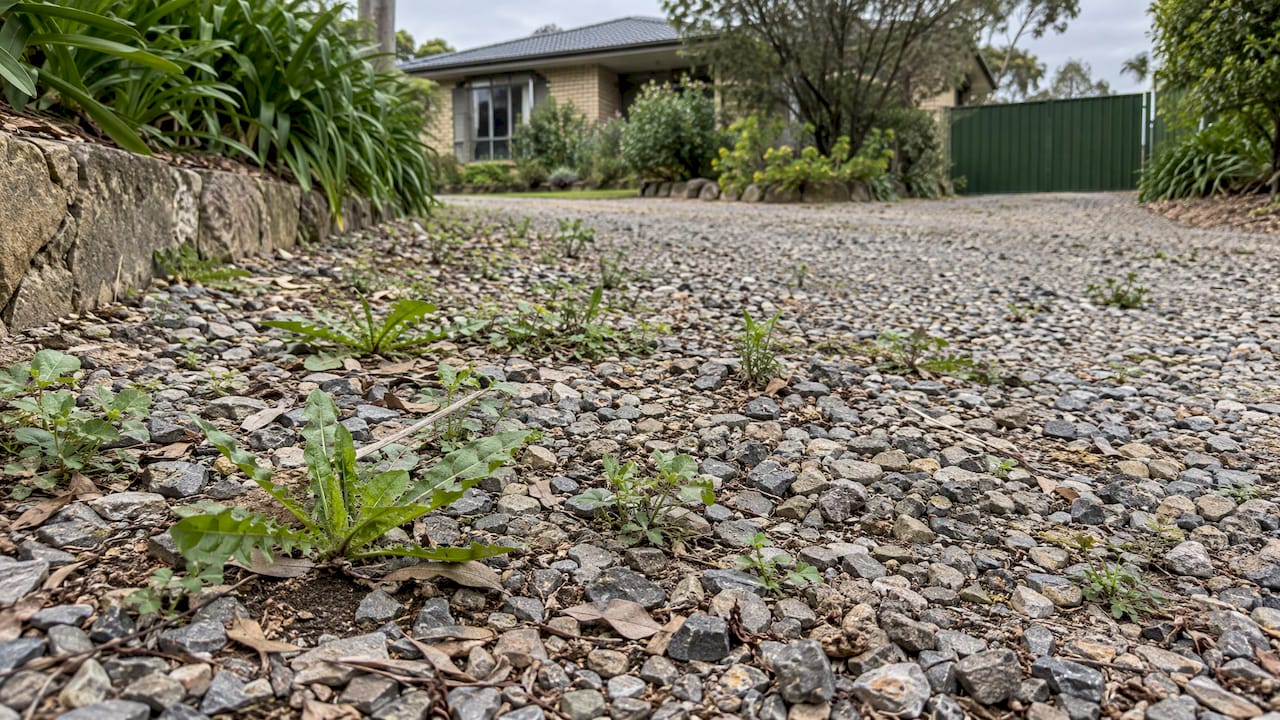
Weeds in gravel come back because most of them aren’t growing up from the soil. They start in the thin layer of dust, leaf litter and blown soil that settles between the stones, so clearing the surface once never lasts. The fix is a two-part job: kill what’s growing now, then stop new seed from establishing. Our crew does that on driveways, fence lines and gravel paths across Wollondilly and Illawarra through our weed spraying service, and this guide explains what’s going on so you know what a proper job looks like.
TL;DR
Most gravel weeds sprout in debris sitting on top of the stones, not from underneath. That’s why a weed mat alone doesn’t fix them.
Killing the leaves isn’t enough. Weeds that regrow from roots or runners, like couch, kikuyu, oxalis and nutgrass, need follow-up.
Spraying the right product at the right time, then keeping the surface clean, is what gives you months of clear gravel instead of weeks.
Salt, boiling water and vinegar can burn off small weeds, but they’re patchy on tougher ones and salt can leave soil bare for years.
We spray driveways, fence lines and gravel areas across Wollondilly and Illawarra, and quotes are no-obligation.
Table of Contents
Where gravel weeds actually come from
People assume weeds push up through the stones from the ground below. Some do, but most don’t. Over a year or two, gravel collects leaves, dust, soil from tyres and boots, and wind-blown seed. That mix breaks down into a fine, dark layer between the stones, and it’s a perfect seed bed. Rain keeps it damp, and the stones hold warmth.
You can tell which kind you have by pulling one. If the root runs down through the gravel into firm soil below, it’s coming from underneath. If the roots are shallow and sitting in a skin of fine dark material between the stones, it germinated in the debris on top.
That difference matters because the two problems need different fixes:
Top-down weeds (the majority) are fixed by killing them, then keeping the surface clean and stopping new seed from taking hold.
Bottom-up weeds are usually perennials with strong roots or runners. They need a proper knockdown and often more than one pass.
The weeds we see in local gravel
In the Wollondilly and Illawarra climate, the usual suspects are:
Couch and kikuyu, which creep in from the lawn edge and run along under the surface
Summer grass and winter grass, which seed heavily and pop up after rain
Bindii and clover, mostly along the edges of lawns
Oxalis and nutgrass, which regrow from underground bulbs and tubers, so pulling the top off does nothing
Chickweed and moss, in shaded and damp corners
If your gravel sits next to a lawn, expect the grasses. If it sits under trees, expect leaf litter to build up fast and the weeds to follow.
Why pulling and weed mat only go so far
Hand weeding works on small weeds when the soil is moist, and it’s fine for a handful of seedlings. On a long driveway it’s slow, and with oxalis, nutgrass and couch it often leaves the underground parts behind. Those regrow within weeks.
Weed mat (landscape fabric) has a similar limit. Laid properly under a decent depth of gravel, it blocks weeds coming from below and stops the stone sinking into the soil. But it does nothing about seed landing on top. Once a layer of dust and leaves builds up over the fabric, weeds root in that layer and the roots can grip the mat, which makes them harder to pull. Two other common problems:
Fabric laid over existing weeds. Couch, kikuyu and nutgrass can push through, so the area needs treating before anything goes down.
Gravel that’s too thin. If it’s only a thin scattering, light reaches the soil and seeds strike. Gravel that has migrated into the lawn over the years often leaves bare patches that weed up first.
So a membrane helps, but it’s a barrier, not a cure. The surface still needs attention.
The homemade options, and what they do
If you’ve searched this topic you’ve seen the vinegar, salt and dishwashing liquid recipe. Here’s what each part does:
Vinegar burns the leaves it touches. Kitchen vinegar is weak, so it suits only young annual weeds on a hot, sunny day. Weeds with deep roots or runners usually reshoot within a couple of weeks.
Dishwashing liquid just helps the mix stick to the leaf.
Salt doesn’t break down. It builds up in the soil and can leave ground bare for years, and it washes toward garden beds and lawn edges. That’s a real problem next to a lawn or trees.
Boiling water will spot-kill small weeds in a crack, but it’s impractical across a whole driveway and does nothing for deep roots.
These are short-term knockdowns. For a driveway or long fence line you’ll be repeating them all season, and the salt risk is the main reason we’d steer you away from it near anything you want to keep alive.
How to clear weeds from gravel properly
This is the routine that gives lasting results. At each step we’ve noted where it tends to go wrong and what we handle for you.
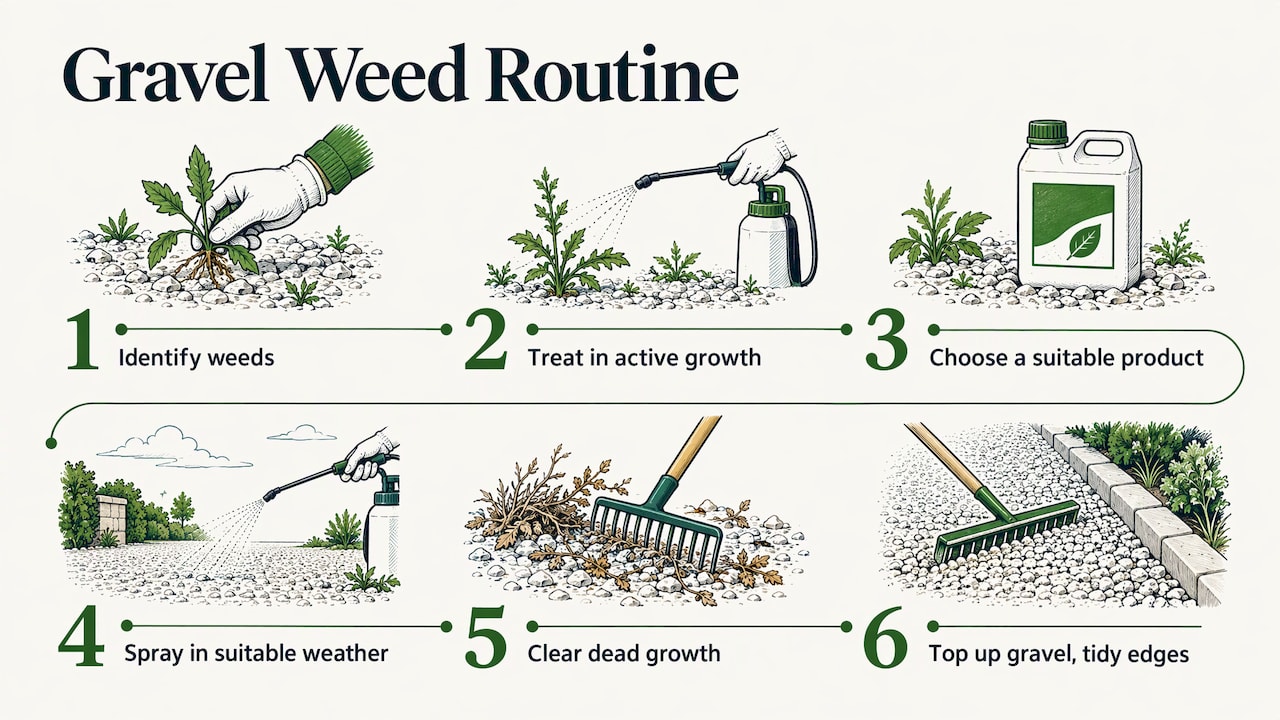
1. Identify what you’re dealing with
Look at the weeds before choosing a treatment. Grasses, broadleaf weeds and bulb-forming weeds respond differently. Woody weeds like blackberry or small saplings need their own approach. On acreage and fence lines you’ll often have a mix.
Where it goes wrong: treating everything the same way. A spray that wilts a young annual may only slow down a nutgrass clump.
What we do: our crew identifies the weeds on the day and sprays accordingly, including driveways and fence lines.
2. Treat while weeds are small and actively growing
Most herbicides work best when the weed is growing strongly and isn’t stressed by drought or frost. Spraying a dried-off, dormant weed wastes product. In our region that generally means spring and autumn flushes, plus any warm, wet spell in summer. Once weeds flower and set seed, you’re refilling the seed bank for next season.
Where it goes wrong: waiting until the driveway is green and knee-high, then trying to deal with it all in one go.
3. Choose the right kind of product
There are two broad types used on gravel:
Knockdown sprays kill the growth that’s there. They don’t stop new weeds from germinating, so on bare ground they may be needed several times a year.
Residual (soil-active) products act on the ground and stop new seed germinating for months. They need more care. Used near plants you want to keep, roots can take them up, and on compacted surfaces or near drains, rain can carry them to places they shouldn’t go.
Combining the two is the usual approach: knock down what’s there, then lay down a residual to hold it back. It cuts the number of sprays needed across a season.
Where it goes wrong: using a residual near a lawn edge, tree roots or a garden bed, or spraying a hazardous product that was never meant for home use. Some agricultural herbicides, such as paraquat-based products, are registered for farm use only and are labelled as too hazardous for the home garden.
What we do: we handle the product choice and the application, and our operations are fully insured.
4. Spray on the right day
Pick a still, dry day, ideally in the morning. Wind carries spray onto lawns, plants and your neighbour’s side of the fence. In NSW you’re expected to take reasonable steps to prevent spray escaping your property, and that includes boundary weeds, where you shouldn’t spray the other side without the neighbour’s say-so. Always read the label and follow the mixing rate; stronger isn’t better and often just damages what’s around it.
Where it goes wrong: spraying in a breeze, over-applying, or skipping gloves, long sleeves and eye protection. Keep kids and pets off until the spray has dried.
5. Clear the dead growth
Once the weeds have died back, rake or blow the dead material off. Leaving it behind just adds to the debris layer that feeds the next round of seedlings. A leaf blower is often better than a rake on gravel because raking shifts the stone around and can expose the soil or the fabric.
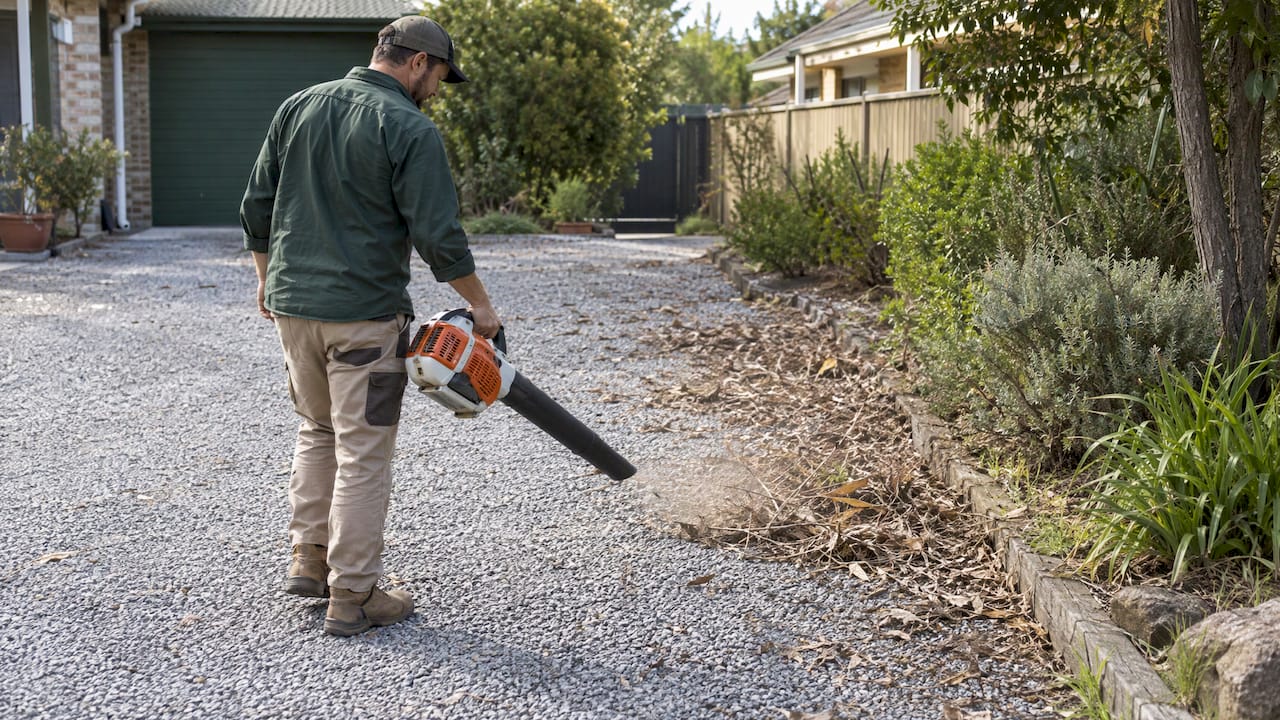
What we do: we offer green waste removal, so the dead growth and leaf litter leave with us rather than sitting in a pile in your yard.
6. Top up and tidy the edges
If the gravel has thinned or migrated into the lawn, top it up so it’s deep enough to block light. A few centimetres is the usual aim for driveways, noticeably more than a light scattering. Cut a clean edge where lawn meets gravel so runners from couch and kikuyu don’t creep in. Edging does more here than fabric, because couch can travel by runner under a barrier.
If garden beds sit alongside the gravel, a layer of mulch reduces the seed blowing onto the stones. Our garden bed tidy-ups and mulching, covered under lawn and garden care, are set up for exactly this.
Keeping gravel clear through the year
The first clean-up is the hardest. After that, a light routine does the job:
Blow or sweep leaf litter before it breaks down into a soil layer. Under trees, that might be every few weeks in autumn.
Pull or spot-treat new seedlings as soon as you see them, before they flower.
Check after rain. A warm, wet week is when a bare-looking driveway turns green.
Keep the lawn edge cut so grasses don’t send runners into the gravel.
Top up gravel when it thins, rather than waiting for bare patches.
Some people use flame weeding on gravel as a regular routine. It works on small, young weeds and needs a pass every few weeks through spring and summer to stop anything setting seed. In fire season it’s not something we’d suggest doing on dry, grassy acreage, so check local fire restrictions first.
Gravel driveways on acreage
Long driveways, fence lines and paddock gates are where DIY gets expensive in time. A 100 metre driveway means a lot of walking with a backpack sprayer, plus the weeds along both edges. Add the verge and the strip along the fence, and one tidy-up can take most of a weekend.
This is where booking helps. Our small acreage mowing crews already work on blocks across Wollondilly, and weed spraying along driveways and fence lines fits into the same visit pattern. If you also have hedges along the drive, we trim hedges up to 5 m, so the one crew can handle the lot. For fire season, seasonal and fire-season mowing around the driveway keeps the grass short where it matters most.
Getting it done across Wollondilly and Illawarra
We’re locally owned and operated, and we work across Picton, Tahmoor, Bargo, Appin and Wilton in Wollondilly, and through Wollongong, Figtree, Unanderra, Dapto, Shell Cove, Albion Park and Albion Park Rail in Illawarra. If you’re in the Wollondilly area, our Wollondilly page lists the suburbs we cover, with local pages for Appin, Bargo and Tahmoor.
The reasons people book us for gravel and driveway weeds are simple. We turn up when we say we will, one crew handles weed spraying, mowing, hedging and garden tidy-ups, and our quotes are quick and no-obligation.
Get your gravel sorted
If you’d rather not spend a weekend spraying, pulling and carting off dead weeds, we’ll take it on. Our weed spraying covers driveways, fence lines and lawn areas, and our crew can follow it with a garden tidy-up and green waste removal in the same job. Tell us where the gravel is and roughly how big the area is, and we’ll give you a no-obligation quote.

Start with our weed spraying page to request a quote, or head to the main site if you’d also like regular mowing booked in. Seasonal timing matters, so it’s worth asking before weeds set seed in spring.
FAQ
Why do weeds keep growing in my gravel driveway?
Most of them start in the layer of dust, leaves and soil that collects between the stones, not from the ground below. Rain and warmth make it a good seed bed. Unless the surface is cleaned and new seedlings are dealt with early, a fresh crop comes up every season.
Does weed mat stop weeds in gravel?
It stops weeds coming up from underneath, and it keeps the gravel from sinking into the soil. It can’t stop seeds sprouting in debris on top, and weeds already growing in the area can push through if they weren’t treated before it was laid. A mat works best alongside spraying and regular surface clean-ups.
Is vinegar or salt a good way to kill gravel weeds?
Vinegar burns small annual weeds but deep-rooted ones usually regrow in a couple of weeks. Salt stays in the soil and can leave the ground bare for years, and it can wash toward lawns and garden beds. For driveways and fence lines, a professional spray is the more dependable option.
When is the best time to treat weeds in gravel?
Treat when weeds are small and actively growing, ideally on a still, dry morning in spring or autumn. Acting before they flower and set seed stops them multiplying. A tidy-up before winter weeds take hold is worth doing too.
Can you spray weeds on my driveway and fence line?
Yes. Weed spraying including driveways and fence lines is part of what we do across Wollondilly and Illawarra. Send us a few details through our weed spraying page and we’ll get back to you with a no-obligation quote.
Recommended
Comments